
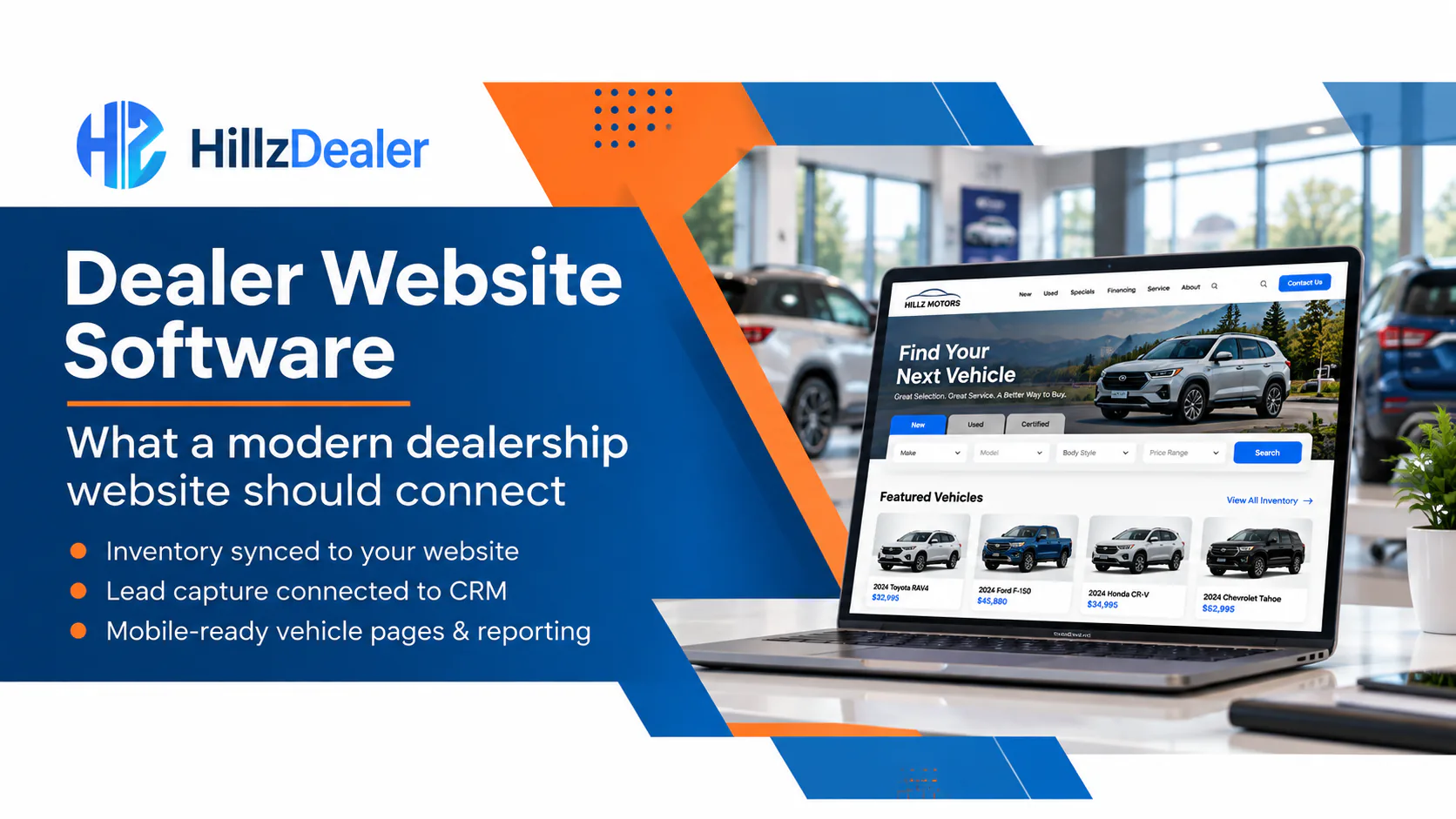
A dealership website is often the first place a shopper meets the dealership. But the website should not operate as a separate brochure that staff must update by hand. The strongest dealership website platforms connect the customer-facing experience with inventory, vehicle information, inquiries, customer follow-up, reporting, and the systems the dealership already uses.
This guide explains what dealerships should compare when evaluating dealer website software, whether the business is an independent dealership, an established single location, a franchise store, or a growing multi-location group in Canada or the United States.
HillzDealer provides dealer website software as part of a connected dealership platform. The exact website, integrations, and workflows available depend on the dealership’s selected products, accounts, configuration, location, and technical requirements.
What Is Dealer Website Software?
Dealer website software is a website platform designed around automotive retail. In addition to standard pages about the dealership, it can support changing vehicle inventory, searchable listings, individual vehicle detail pages, customer inquiries, dealership branding, mobile browsing, and connections to dealership systems.
A general-purpose website builder can produce an attractive site, but a dealership usually has requirements that change every day. Vehicles are acquired, prepared, priced, photographed, listed, reserved, and sold. Customers ask about specific vehicles. Salespeople need useful lead information. Managers need to understand which activity is producing inquiries.
The key question is therefore not only, “Does the website look good?” It is, “How well does the website connect with the work happening behind it?”
1. Inventory Should Remain Connected with the Website
Vehicle inventory is the centre of most dealership websites. If inventory information is maintained separately in the dealership system and on the website, the team may need to repeat updates to pricing, photos, availability, specifications, and status.
When comparing platforms, ask how the website receives vehicle information, how often supported updates appear, what happens when a vehicle is sold or unavailable, and which fields the dealership can control. Also ask how the provider handles images, pricing rules, missing information, and any third-party listing connections.
A connected approach can keep customer-facing vehicle pages closer to the records used by the dealership team. HillzDealer inventory management can organize vehicle information, pricing, costs, photos, status, merchandising, customer activity, and deal progress, while supported website configurations can present connected inventory to shoppers.
Connection details still matter. Website and marketplace availability can vary according to provider accounts, dealership configuration, selected products, location, and technical requirements. A provider should explain those dependencies before implementation.
2. Vehicle Detail Pages Need More Than a Photo Gallery
Each available vehicle should have a dedicated, understandable page. A useful vehicle detail page may include photos, specifications, price information, dealership details, relevant disclosures, and clear ways for a shopper to contact the dealership.
Dealerships should review whether vehicle pages are:
- usable on phones, tablets, and desktop devices
- supported by clean, stable URLs
- built with crawlable HTML where appropriate
- connected with the correct vehicle status and information
- easy to navigate from vehicle-search results
- clear about the action a shopper can take next
- structured so related vehicles can be explored without starting over
The provider should also explain what is automatic, what the dealership controls, and what happens when data is incomplete. A website should not invent vehicle facts or hide important information behind an image.
3. Website Inquiries Should Enter a Clear Lead Workflow
A form submission has little value if it lands in an isolated inbox without the vehicle, source, or customer context the sales team needs.
Dealer website software should give shoppers clear ways to ask about a vehicle, contact the dealership, or request a next step. Supported inquiry data can then connect with customer and lead workflows, including the vehicle of interest, lead source, salesperson responsibility, follow-up activity, communication, and deal progression.
When evaluating a provider, test the complete path:
- Submit a safe test inquiry on the website.
- Confirm that the customer sees an accurate success or error message.
- Confirm where the lead appears and which information is attached.
- Check how salesperson assignment and follow-up are handled.
- Verify that duplicate clicks or refreshes do not create avoidable duplicate records.
- Confirm how managers can review response activity and lead status.
HillzDealer can connect supported website inquiries with its automotive CRM, bringing customer records, vehicle interests, lead-source context, assignment, tasks, communication, and deal connections into the wider dealership workflow. Exact behavior depends on the selected setup.
4. The Mobile Experience Is Part of the Sales Experience
A responsive website is not simply a desktop page made smaller. Vehicle search, filters, photos, pricing, contact actions, and inquiry forms all need to remain usable at narrow widths.
Dealerships should test real pages on common phone sizes and check:
- navigation and filters without sideways page scrolling
- readable vehicle information and pricing
- appropriately sized tap targets
- image loading and stable page layout
- visible calls to action without covering content
- short, clearly labelled forms
- validation and error messages that can be understood
- a logical reading order for keyboard and assistive-technology users
The best test is not a polished homepage screenshot. It is a complete journey from inventory search to a specific vehicle and then to a successful inquiry.
5. Search Visibility Starts with a Sound Website Foundation
No website platform can guarantee a first-page Google ranking. Search visibility depends on content quality, competition, location, authority, technical performance, and the search engine’s own systems.
However, dealer website software can provide a better foundation for search engines and AI-powered discovery systems to understand the dealership. Useful elements include descriptive page content, clean URLs, meaningful page titles and descriptions, structured headings, crawlable inventory pages, internal links, canonical URLs, XML sitemap support, and relevant structured data.
Technical foundations do not replace useful dealership content. Location information, inventory context, services, team expertise, policies, and helpful answers still need to be accurate and readable. Avoid thin pages created only to target a city or keyword. One strong, trustworthy page is usually more useful than many near-duplicate pages.
When a provider discusses SEO, ask which items are included in the platform, which require ongoing content work, who controls metadata and redirects, and how performance or indexing issues are investigated.
6. The Dealership Should Retain Practical Content and Brand Control
The website should reflect the dealership rather than look like a generic template with a different logo. At the same time, customization should not make routine updates difficult or create an inconsistent customer experience.
Ask which parts of the site the dealership can manage, including:
- dealership logo and brand colours
- page content and navigation
- promotional sections and calls to action
- dealership and location information
- vehicle presentation
- images and media
- contact information
- legal or disclosure content supplied by the dealership
Also clarify ownership and transition requirements. The dealership should understand how domains, website content, redirects, analytics access, inventory feeds, form destinations, and exported information are handled if the website provider changes.
7. Reporting Should Connect Website Activity with Dealership Outcomes
Basic traffic counts do not tell managers whether website activity is becoming useful customer activity. A stronger reporting approach can connect supported website activity with vehicle interest, inquiries, lead sources, CRM activity, and dealership workflows.
When comparing providers, ask which reporting is built in, which analytics services are connected, how consent affects measurement, and whether managers can distinguish a page visit from an accepted inquiry. Website metrics and dealership records should not be treated as identical evidence.
HillzDealer dealership reporting and analytics can connect reporting across supported sales, lead, inventory, deal, accounting, and multi-location workflows. Website reporting availability depends on selected products, configuration, and connected services.
8. A Website Provider Should Fit the Dealership’s Operating Model
An independent used-vehicle dealership, a franchise store, and a multi-location group may need different content controls, inventory views, user responsibilities, integrations, and reporting.
Before choosing a provider, map the current environment:
- number of dealership locations and websites
- new, used, or mixed vehicle inventory
- current inventory and CRM systems
- inventory feeds and listing destinations
- lead assignment and follow-up process
- analytics and reporting requirements
- required dealership or manufacturer branding
- domain, hosting, and migration responsibilities
- employee access and approval needs
- launch, training, support, and rollback expectations
Larger organizations should also ask how location-based inventory, dealership content, employee access, reporting, and group visibility are handled. HillzDealer’s franchise and multi-location dealership software is designed to connect supported dealership operations across locations, with configuration based on the organization’s real requirements.
Dealer Website Software Comparison Checklist
| Area | Questions to ask |
|---|---|
| Inventory | How do vehicle records, pricing, photos, and status reach the website? |
| Vehicle pages | Are pages mobile-friendly, crawlable, and connected to accurate inventory data? |
| Lead capture | Where do accepted inquiries go, and is vehicle/source context retained? |
| CRM | Can supported website leads connect with assignment, tasks, communication, and deal workflows? |
| Mobile | Can shoppers search inventory, view vehicles, and submit forms comfortably on a phone? |
| SEO foundation | Who controls titles, descriptions, URLs, redirects, sitemaps, canonicals, and structured data? |
| Content and brand | What can the dealership edit, and which changes require the provider? |
| Reporting | Can website activity be connected with inquiries, vehicle interest, and dealership outcomes? |
| Integrations | Which connections are supported, and what accounts, APIs, or configuration do they require? |
| Migration | Who controls the domain, content, data, redirects, analytics, launch, and rollback plan? |
| Growth | Can the platform support additional inventory, users, locations, and operational workflows? |
Connected Website Software vs. a Stand-Alone Website
A stand-alone website can still be appropriate when a dealership has a simple operation or already has reliable integrations. The tradeoff is the amount of manual work and coordination required to keep inventory, inquiries, customer records, reporting, and dealership systems aligned.
A connected website becomes more valuable when the dealership wants the online showroom to operate as part of the same environment as its inventory, customers, leads, deals, documents, and reporting. HillzDealer’s Dealer Management System brings these areas into a broader connected platform rather than treating the website as an isolated marketing tool.
The right decision depends on the dealership’s actual workflow. Compare the complete path from vehicle record to website listing, customer inquiry, employee follow-up, and management reporting—not only the homepage design.
Frequently Asked Questions
What is dealer website software?
Dealer website software is a customer-facing website platform designed around automotive dealership requirements such as changing vehicle inventory, vehicle detail pages, customer inquiries, mobile browsing, dealership branding, CRM connections, and search-friendly site structure.
How is a dealership website different from a general website builder?
A general website builder can create pages and forms. Dealership website software is designed to support automotive inventory, searchable vehicle listings, vehicle-specific inquiries, and connections with dealership workflows. The exact capabilities depend on the provider and configuration.
Can dealership inventory appear automatically on the website?
Supported configurations can connect dealership inventory with customer-facing listings and vehicle detail pages. Update frequency, included fields, third-party feeds, and publication rules depend on the platform, provider accounts, and dealership setup.
Can website leads connect with a dealership CRM?
Yes, when the website and CRM support the connection. Useful lead records may include customer details, vehicle interest, source information, assignment, tasks, communication, and follow-up status.
What should a mobile-friendly dealer website support?
It should make navigation, inventory search, vehicle pages, photos, pricing, contact actions, and forms usable across compatible phone, tablet, and desktop sizes.
Is dealer website software automatically SEO friendly?
A platform can provide a search-friendly technical foundation, but it cannot guarantee rankings. Search visibility also depends on useful content, competition, location, authority, technical quality, and search-engine systems.
Can one website platform support independent, franchise, and multi-location dealerships?
Some platforms can support a range of dealership sizes, but the configuration should match the operation’s inventory, locations, brand requirements, users, integrations, and reporting needs.
What should a dealership prepare before switching website providers?
Document the current domain and hosting access, website content, inventory feeds, CRM and lead routing, analytics, integrations, redirects, legal content, branding, user responsibilities, launch checks, and rollback requirements.
Related Reading
- Modern Automotive DMS: Connecting Dealership Operations
- Automotive CRM vs Generic CRM: What Car Dealerships Should Compare
Topics