
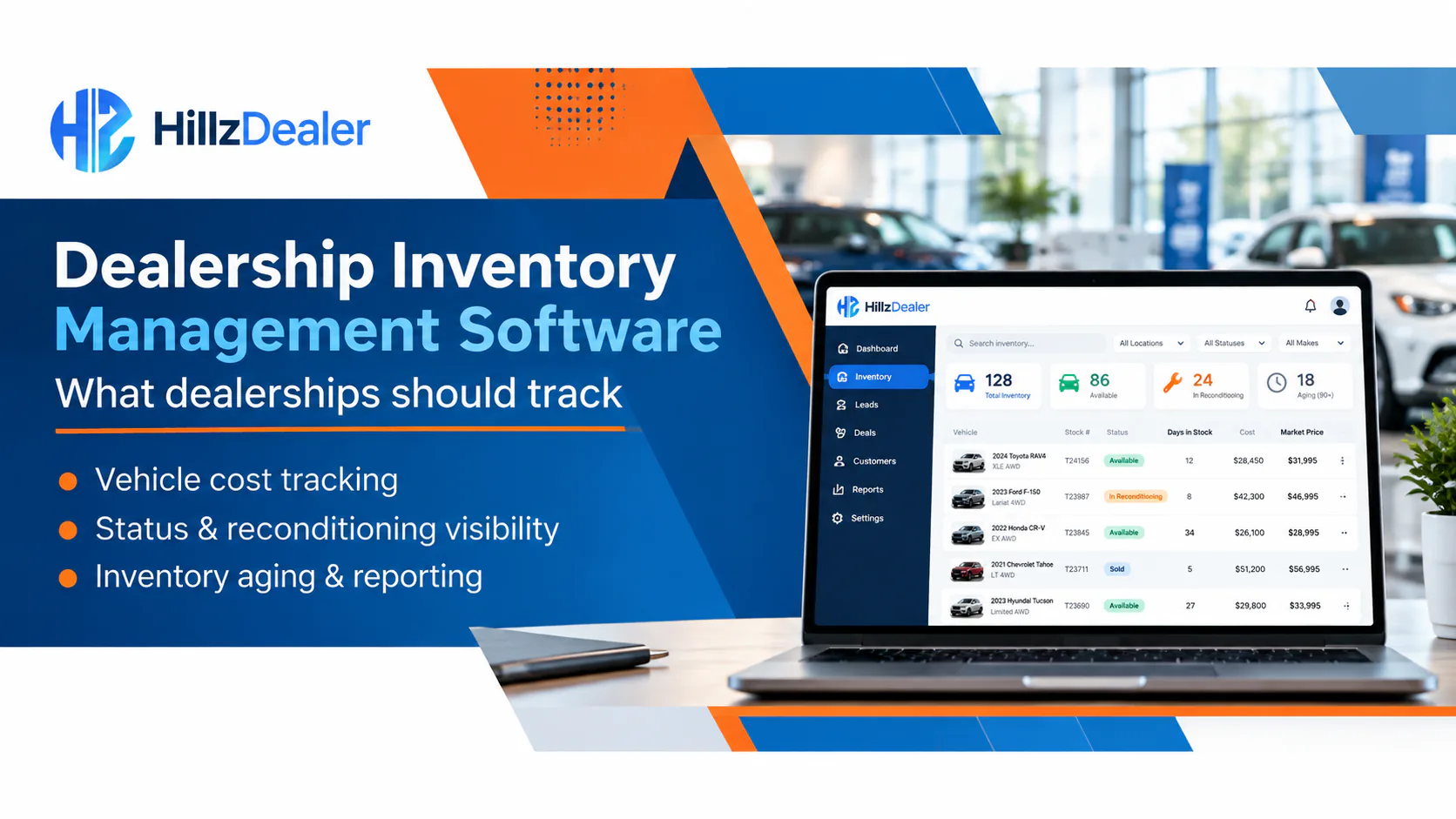
A dealership inventory system should do more than keep a list of vehicles.
For a modern automotive dealership, every vehicle carries operational information from the moment it is acquired until the moment it is sold: VIN and specifications, purchase information, location, pricing, reconditioning activity, costs, photos, customer interest, deal activity, and reporting data.
When those records live in separate spreadsheets, inboxes, websites, and software tools, dealership teams can spend unnecessary time reconciling information instead of managing inventory.
That is why dealerships comparing dealership inventory management software should look beyond simple vehicle listings. The stronger question is: how well does the system connect each vehicle to the rest of the dealership operation?
HillzDealer provides automotive inventory management software as part of a connected dealership platform for new- and used-vehicle dealerships across Canada and the United States.
1. Start with one complete vehicle record
The foundation of dealership inventory management is a reliable vehicle record.
A useful system should make it easy for authorized employees to review important information such as:
- VIN and vehicle specifications
- stock number
- year, make, model, and trim
- mileage and condition
- inventory status
- dealership or location
- pricing information
- vehicle notes
- photos
- cost information
- customer and deal activity
The goal is not simply to store more fields. It is to give dealership employees one clearer place to understand the current state of a vehicle.
HillzDealer Inventory Management keeps vehicle information, status, pricing, costs, photos, customer activity, and deal progress within a connected inventory record. Dealerships that also use the broader HillzDealer Dealer Management System can keep that inventory information closer to customer, deal, document, accounting, and reporting workflows.
2. Track acquisition and vehicle costs—not only asking price
A vehicle's advertised price is only one part of its financial picture.
Dealership management may also need visibility into acquisition cost and applicable expenses associated with getting the vehicle ready for sale. Depending on the dealership's workflow, this may include purchase information, transportation, vendor charges, repair expenses, reconditioning costs, and other vehicle-related costs.
Keeping those amounts connected with the vehicle record gives management a stronger operational foundation for reviewing inventory decisions and deal profitability.
HillzDealer connects applicable vehicle costs with inventory and broader dealership accounting workflows, helping dealerships keep relevant financial information closer to the vehicles and transactions that created it.
3. Know the vehicle's real status
An inventory count alone does not tell the full story.
Two vehicles may both be physically on the lot, but one may be ready to merchandise while the other is still waiting for inspection, repair, detailing, photos, pricing review, or management approval.
A stronger inventory workflow makes status visible so employees can quickly understand what needs attention.
Useful status information can include:
- acquired
- in preparation
- undergoing repair or reconditioning
- ready for photos
- ready for merchandising
- available
- connected to an active deal
- sold or otherwise removed from active inventory
The exact workflow varies by dealership, but the principle is consistent: inventory software becomes more useful when status reflects the vehicle's operational reality.
For dealerships that need deeper preparation visibility, HillzDealer also offers vehicle reconditioning software that connects supported preparation activity, repair records, vendors, costs, notes, status, and inventory information.
4. Connect reconditioning to inventory
Vehicle preparation is often where disconnected processes appear.
A vehicle may arrive, move to a service bay, go to an outside vendor, require parts or cosmetic work, and then return to the dealership before it is ready for sale. If each stage is tracked in separate messages or spreadsheets, employees may have difficulty seeing the complete history.
Connecting reconditioning activity with inventory can help authorized teams review relevant status, vendor activity, repair information, notes, and costs around the same vehicle record.
That connection is especially useful for dealerships managing larger inventories or multiple locations because the vehicle's preparation status becomes part of the broader inventory view rather than a separate process.
5. Track inventory age and days in stock
Inventory reporting should help managers identify which vehicles deserve attention.
One useful measure is how long a vehicle has remained in inventory. Reviewing inventory aging and days in stock can help management decide which units may need a pricing review, merchandising update, additional promotion, or another operational action.
The important point is not that software should automatically decide what to do. It should make the relevant information easier to see.
HillzDealer's dealership reporting and analytics software connects supported inventory information with wider sales, deal, customer, accounting, and operational reporting. Its reporting capabilities include inventory aging and days-in-stock visibility alongside other dealership measures.
6. Connect customer interest to the actual vehicle
Inventory management and CRM should not operate as completely separate worlds.
When a customer asks about a vehicle, the dealership benefits from keeping the customer's interest connected with that specific inventory unit. Salespeople and managers can then work with clearer context around the customer, the vehicle, communication, follow-up, appointments, and deal progress.
HillzDealer connects inventory with its automotive CRM, allowing supported customer and lead activity to remain closer to vehicle interests and dealership sales workflows.
This matters whether a lead originates from the dealership website, a marketing source, a social channel, or another supported source.
7. Keep website inventory connected
A dealership website is most useful when its vehicle information is connected with the inventory system behind it.
Maintaining separate operational inventory records and customer-facing vehicle pages can create unnecessary duplicate work. A connected workflow can help keep supported vehicle information, photos, pricing, availability, and inquiry activity closer together.
HillzDealer's dealer website software can connect dealership inventory with customer-facing inventory pages and vehicle detail pages. Supported website inquiries can also connect with customer and CRM workflows.
For dealerships comparing car dealer inventory software, this connection between internal inventory and the online showroom is worth examining closely.
8. Give employees practical mobile access
Inventory work happens on the lot, at auctions, between departments, and across dealership locations—not only at a desk.
Mobile access can help authorized employees review or update supported vehicle information while they are near the inventory itself.
HillzDealer's mobile dealer management app supports inventory access and practical mobile workflows including vehicle information, photos, notes, pricing information, and supported VIN scanning.
The benefit is straightforward: dealership employees can work with connected inventory information without returning to a primary workstation for every task.
9. Support single-location and multi-location inventory visibility
As dealerships grow, inventory visibility becomes more complex.
A single-location dealership may primarily need clear status, pricing, costs, photos, and customer activity. A multi-location operation may additionally need to understand where vehicles are located, which employees are responsible for them, and how inventory performs across locations.
A dealership inventory system should therefore be evaluated not only for today's vehicle count but also for the dealership structure it may need to support later.
HillzDealer is designed for independent dealerships, franchise operations, single locations, and multi-location automotive groups across North America. Inventory can be connected with broader dealership users, locations, CRM, deals, accounting, websites, mobile access, and reporting according to the selected configuration.
10. Look for connected reporting—not another isolated dashboard
A useful inventory dashboard should help management answer practical questions such as:
- Which vehicles are currently available?
- Which vehicles are still being prepared?
- Which units have been in stock the longest?
- What costs are associated with a vehicle?
- Which vehicles are receiving customer interest?
- Which vehicles are connected to active deals?
- What is happening across different dealership locations?
The value increases when those answers come from connected operational records instead of manually combined exports.
That is why dealerships evaluating automotive inventory management software should look at the complete information flow—from acquisition and preparation to merchandising, customer interest, deal activity, accounting, and reporting.
What should dealerships compare when choosing inventory software?
Before selecting a system, ask vendors to demonstrate the actual vehicle workflow rather than only showing an inventory grid.
A practical evaluation should include vehicle creation, VIN information, cost tracking, status changes, photos, reconditioning, website publishing, CRM connections, deal connections, reporting, mobile access, and multi-location visibility where relevant.
Also ask which functions are included in the proposed package, which depend on integrations or provider accounts, and how the system will be configured for your dealership.
HillzDealer can be configured around dealership inventory volume, users, locations, workflows, websites, marketplace connections, reporting, onboarding, and support requirements.
A connected inventory system can support the wider dealership
Inventory sits at the center of many dealership workflows.
The same vehicle can be connected to acquisition costs, preparation activity, website merchandising, customer inquiries, appointments, negotiations, documents, payments, accounting records, reporting, and the final transaction.
Treating inventory as a connected operational record can therefore be more useful than treating it as a standalone list of vehicles.
For dealerships in the United States, Canada, and across North America, HillzDealer brings inventory together with DMS, CRM, accounting, documents, dealer websites, mobile access, reporting, and supported AI-assisted workflows within one dealership platform.
Explore HillzDealer Inventory Management or request a personalized demonstration to review the workflows most relevant to your dealership.
Frequently Asked Questions About Dealership Inventory Management Software
What is dealership inventory management software?
Dealership inventory management software helps automotive dealerships organize vehicle information such as VIN data, status, location, pricing, costs, photos, customer activity, deal progress, website merchandising, and reporting within a structured system.
What should car dealer inventory software track?
Useful car dealer inventory software should track more than basic vehicle details. Depending on the dealership's needs, it can include acquisition information, costs, status, location, reconditioning activity, pricing, photos, customer interest, deal activity, aging, and reporting.
Can dealership inventory software connect with a CRM?
Yes. A connected dealership platform can associate customer and lead activity with vehicle interests, communication, appointments, follow-up tasks, and deal workflows. HillzDealer connects inventory with its automotive CRM and broader dealership-management platform.
Can vehicle reconditioning costs be connected to inventory?
HillzDealer supports applicable repair, vendor, preparation, and reconditioning expenses and can keep that information associated with relevant vehicle and dealership records.
Does HillzDealer support dealerships in the United States and Canada?
Yes. HillzDealer supports new- and used-vehicle dealerships across Canada and the United States, including independent dealerships, franchise operations, and multi-location groups.
Can inventory be managed from a mobile device?
HillzDealer Mobile supports applicable inventory workflows from compatible mobile devices, including reviewing and updating supported vehicle information, photos, notes, and VIN-related workflows.
Topics