
A dealership lead can begin almost anywhere.
A shopper might submit an inquiry from the dealership website, call about a vehicle, respond to a marketing campaign, send a message, visit the showroom, or speak with a salesperson about a particular car, truck, SUV, or other vehicle.
The challenge is what happens after that inquiry arrives.
- Who owns the lead?
- Has anyone responded?
- Which vehicle is the customer interested in?
- When should the salesperson follow up?
- Has an appointment been scheduled?
- What was discussed during the previous conversation?
- Has the opportunity moved forward, or is it waiting for attention?
When customer information is spread across individual inboxes, spreadsheets, calendars, personal notes, and disconnected applications, dealership employees can spend unnecessary time trying to reconstruct the customer journey.
A car dealership CRM gives salespeople and managers a structured way to organize leads, communication, appointments, follow-up activity, vehicle interests, and sales opportunities.
For automotive dealerships across the United States, Canada, and the wider North American market, CRM can become an important part of a connected dealership sales process.
What Is a Car Dealership CRM?
A car dealership CRM, or customer relationship management system, is software designed to help automotive dealerships organize customer and lead activity throughout the sales process.
A dealership CRM may connect information such as:
- Customer contact information
- Lead source
- Vehicle interest
- Assigned salesperson
- Communication history
- Follow-up activity
- Tasks and reminders
- Appointments
- Campaign activity
- Sales-opportunity status
- Inventory information
- Deal activity
The objective is not simply to store customer names. A useful CRM should help authorized dealership employees understand what has already happened with a customer and what needs to happen next.
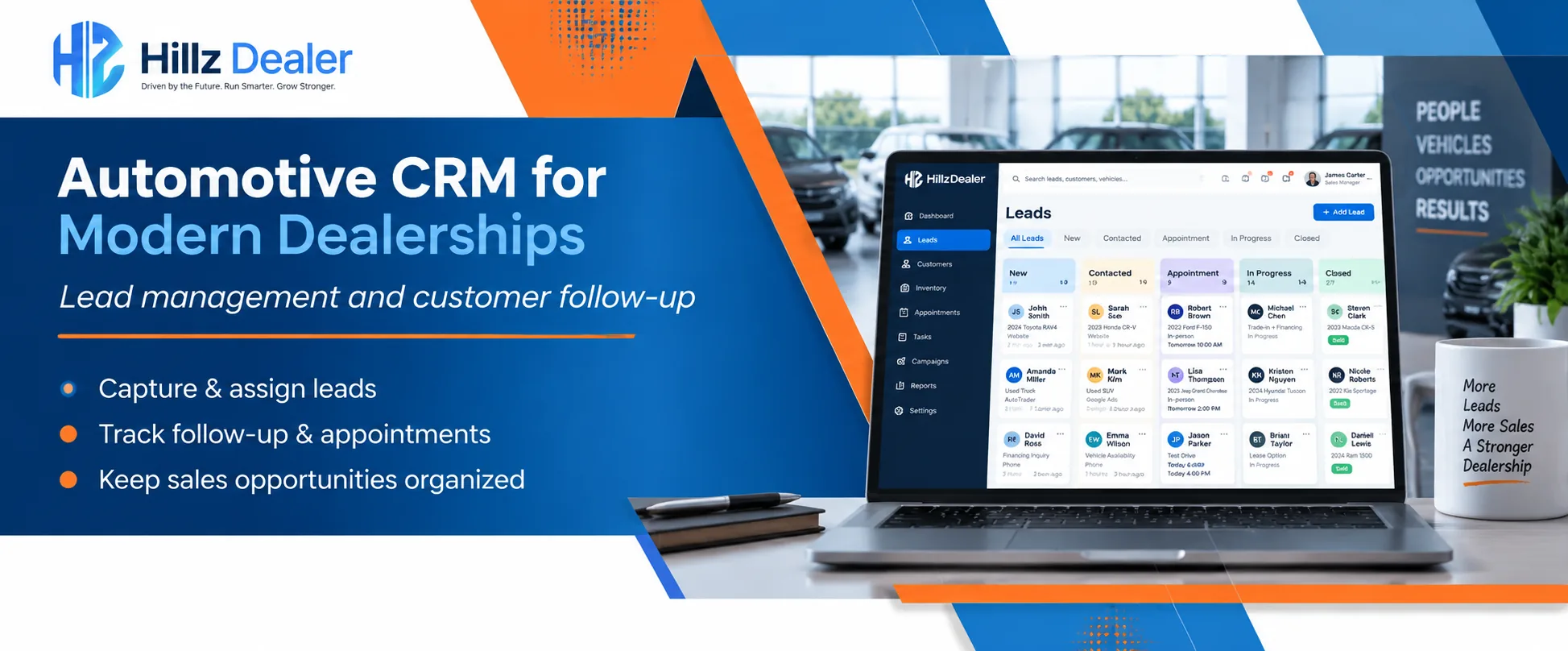
HillzDealer Automotive CRM brings leads, customers, communication, appointments, follow-up tasks, campaigns, vehicle interests, and sales activity into one connected dealership CRM.
Bring Dealership Leads Into an Organized Workflow
Lead management begins when a new customer inquiry enters the dealership. Without a structured workflow, opportunities can become distributed across website notifications, employee email accounts, phone conversations, messages, spreadsheets, social platforms, and other sources.
That makes it difficult for management to answer a basic question: What happened to every opportunity that entered the dealership?
A CRM creates a central customer and lead record where the dealership can maintain information about the customer, source, relevant vehicle, assigned salesperson, current status, and follow-up activity.
HillzDealer supports centralized lead records, lead assignment and distribution, lead-source visibility, customer and vehicle interests, follow-up activity, and lead-status tracking. The result is a more structured sales process instead of one that depends entirely on individual employee memory.
Connect Customers With the Vehicles They Want
Vehicle interest is an important part of automotive CRM. A dealership customer is rarely only a name, telephone number, and email address. They may be interested in a specific SUV, truck, sedan, EV, used vehicle, new model, price range, or trade opportunity.
Connecting the customer record with vehicle interest gives the salesperson better context when continuing the conversation. It also creates an important relationship between CRM and inventory management.
When a shopper asks about a particular vehicle, the dealership should be able to keep that vehicle interest connected with the customer as the opportunity progresses. HillzDealer CRM records can connect customer and vehicle interests, while the wider platform links CRM activity with inventory and deal workflows.
Assign Leads and Maintain Clear Responsibility
Capturing a lead is only the beginning. Someone has to be responsible for the opportunity.
Depending on the dealership's workflow, leads might be assigned according to salesperson availability, department, store location, source, vehicle type, or management decision. Different dealerships will organize lead assignment differently. What matters is that employees and managers can determine who is responsible for the customer.
HillzDealer supports lead assignment and distribution alongside lead history, customer information, vehicle interests, follow-up activity, and lead-status tracking. Clear ownership can help reduce situations where a customer inquiry is overlooked because team members assumed someone else was handling it.
Keep Customer Communication History Together
Dealership conversations can happen through different channels and at different times. A shopper may submit an inquiry, receive an email, exchange text messages, schedule an appointment, make a phone call, and later communicate with another dealership employee.
Without shared customer history, the next employee involved may have little context about what has already happened. That creates unnecessary repetition. A connected CRM helps authorized employees review relevant customer activity before continuing the conversation.
HillzDealer CRM supports email communication, text-message workflows, customer communication history, appointment notifications, and lead and deal context. Supported functionality depends on the dealership's package and configuration.
The customer should not have to restart the entire conversation every time another dealership employee becomes involved.
Turn Follow-Up Into a Defined Dealership Process
Follow-up is one of the areas where CRM becomes operationally important. A salesperson may need to:
- Return a customer's call
- Confirm vehicle availability
- Send requested information
- Follow up after an inquiry
- Reconnect after a dealership visit
- Confirm an appointment
- Review an unresolved opportunity
- Contact a previous customer later
- Complete another sales activity
When these responsibilities exist only in a salesperson's personal notes or memory, management has limited visibility. A CRM can connect tasks directly with the customer or lead.
HillzDealer supports employee task assignment, follow-up reminders, task-status tracking, due dates and priorities, lead-connected activities, and management visibility. This does not replace sales management. It gives management better information for managing the process.
Organize Customer Appointments
An appointment can represent an important step between an initial inquiry and an in-person dealership interaction. A CRM can help keep the appointment associated with the relevant customer, employee, and sales opportunity. This provides dealership staff with better context before the customer arrives.
HillzDealer supports customer appointment records, employee assignment, appointment reminders, lead and deal notifications, and centralized activity history. Instead of treating the calendar as something completely separate from the CRM, appointments can become part of the customer journey.
Give Managers Better Sales-Pipeline Visibility
Salespeople generally work with individual customers and opportunities. Managers need a broader view. A dealership CRM can help management review questions such as:
- Which leads are new?
- Which opportunities are currently active?
- Which salesperson owns each opportunity?
- Which customers have appointments?
- Which follow-up activities still need attention?
- What is the status of customer opportunities?
- Where may additional management attention be needed?
CRM does not eliminate the need for sales management. It can provide better operational information for that management process. HillzDealer's CRM dashboard supports views of customer records, lead activity, employee assignments, follow-up status, campaign and appointment activity, sales opportunities, and CRM reporting.
Connect Dealer Website Leads With CRM
A dealership website should not become another isolated source of customer information. When a shopper views inventory and submits an inquiry, the dealership needs a clear way to continue that conversation.
Connecting the website with CRM helps move supported customer inquiries from the online showroom into dealership sales workflows. HillzDealer's Dealer Website platform connects customer-facing inventory, vehicle detail pages, lead capture, inquiries, and supported CRM workflows.
The customer may begin online. The dealership team can then continue the relationship inside its connected operating environment.
Move the Customer From CRM Into the Deal
CRM should not become a dead end when the customer is ready to purchase. As the opportunity progresses, customer and vehicle information may need to connect with:
- Pricing
- Trade information
- Financing calculations
- Documents
- Signatures
- Payments
- Commissions
- Transaction activity
A connected dealership platform can reduce the need to repeatedly recreate the same customer and vehicle information when a transaction moves from one department to another. HillzDealer connects CRM activity with inventory, deal management, documents, and wider dealership workflows.
Explore the Dealer Management System to see how connected dealership records can support that transition.
Keep the Customer Relationship Going After the Sale
A completed vehicle sale does not necessarily mean the dealership's customer relationship is finished. Previous customers can remain relevant for future vehicle replacement, trade-in opportunities, approved campaigns, referrals, and future dealership communication.
Keeping customer history connected provides dealership employees with better context when those future conversations occur. HillzDealer's broader Deal Management workflow can maintain customer, vehicle, communication, deal, and future follow-up context within the wider platform.
The goal is not excessive customer contact. It is maintaining an organized history so appropriate future activity does not have to start from zero.
CRM for Independent, Franchise, and Multi-Location Dealerships
CRM requirements can vary considerably depending on dealership structure. An independent dealership may want a straightforward way to organize inquiries, vehicle interests, salesperson follow-up, and appointments. A larger dealership may need more employee coordination, management visibility, campaign tools, reporting, and departmental workflows.
A franchise or multi-location operation may also need clearer lead ownership, employee assignments, customer records, vehicle interests, location context, and wider management visibility. HillzDealer supports new- and used-vehicle dealerships, independent dealers, franchise operations, multi-location groups, and Buy Here Pay Here dealership workflows.
Where AI Fits Into Automotive CRM
AI is most useful when it supports a real dealership workflow. Practical applications can involve supporting communication workflows, organizing information, reducing repetitive administrative steps, assisting employees with dealership data, and improving workflow consistency.
AI does not remove the importance of accurate customer records, employee responsibility, human judgment, clear dealership processes, appropriate customer communication, or the salesperson and customer relationship.
HillzDealer positions AI-powered automation as part of a broader connected dealership environment that includes CRM, inventory, deals, accounting, documents, websites, mobile access, reporting, and other dealership workflows.
The useful question for a dealership is not simply whether a CRM uses AI. A more useful question is what dealership work the technology actually helps the team perform.
Automotive CRM Should Connect the Complete Customer Journey
A dealership CRM provides more value when it works with the rest of dealership operations. A customer may begin as a website inquiry. The CRM records the opportunity. The customer becomes connected with a vehicle. A salesperson follows up. An appointment is scheduled. The opportunity progresses. The customer and vehicle move into an active deal. Documents and financial information are prepared. The transaction is completed. Appropriate customer history can remain available afterward.
These steps should feel like one connected dealership workflow rather than a collection of unrelated applications. HillzDealer brings CRM together with dealer management, inventory, deal workflows, accounting, documents, websites, mobile access, reporting, and supported AI-powered automation within a broader dealership-management platform.
Related reading: Compare automotive and generic CRM software to see which workflows matter when choosing a platform for your dealership.
Frequently Asked Questions About Car Dealership CRM Software
What is a car dealership CRM?
A car dealership CRM is customer relationship management software designed to help automotive dealerships organize leads, customer information, communication, appointments, follow-up tasks, vehicle interests, campaigns, and sales opportunities.
Why do car dealerships use CRM software?
CRM software gives dealership employees a structured place to maintain customer and lead information, assign responsibilities, organize communication, schedule follow-up, manage appointments, and review sales opportunities.
What should automotive CRM software include?
Depending on the dealership's requirements, useful CRM capabilities may include centralized lead records, lead assignment, source information, communication history, tasks, reminders, appointments, vehicle interests, opportunity status, campaigns, dashboard visibility, and reporting.
Can dealership CRM software connect with inventory?
Yes. Connecting CRM and inventory can help dealership employees associate customer vehicle interests and sales activity with the relevant vehicle information. HillzDealer connects CRM with inventory and broader dealership workflows.
Can automotive CRM software manage dealership website leads?
A connected CRM can organize supported inquiries originating from dealership websites and other supported sources. HillzDealer's Dealer Website platform connects website inquiries with customer and CRM workflows.
Does HillzDealer CRM support email and text communication?
HillzDealer supports customer communication workflows that may include email, text messaging, notifications, and communication-history functionality depending on the dealership's package and configuration.
Is HillzDealer CRM only for independent used-car dealerships?
No. HillzDealer supports new- and used-vehicle dealerships, independent dealers, franchise operations, multi-location groups, and Buy Here Pay Here dealership workflows.
Does HillzDealer CRM connect with the DMS?
Yes. HillzDealer CRM operates within the broader HillzDealer platform and connects customer and lead activity with inventory, deal workflows, documents, and other dealership information.
Topics